This article accompanies the full documentary film with narration, motion graphics, and original diagrams.
Watch the Full Film on YouTubeCold open
Flip a switch, and a room fills with light. You do not think about it. Nobody does. But behind that small gesture is a chain that runs from a spinning machine, perhaps a hundred miles away, through wires that hum above your street, into the wall beside your hand, and out into the glass above your head, all in less time than it takes to blink.
Two hundred years ago, none of that existed. There were no power plants, no wires, no outlets. Electricity was a parlor trick. Sparks jumped between glass spheres to amuse guests, and doctors zapped patients with it and hoped for the best.
So how did a curiosity become the invisible backbone of civilization? The answer begins not with a famous inventor in a bright laboratory, but with a poor boy in a bookbinder's shop, and one question he refused to stop asking. By the end of this film, you will know what he found, why it changed everything, and why the lights stayed on.
A curiosity in a glass jar
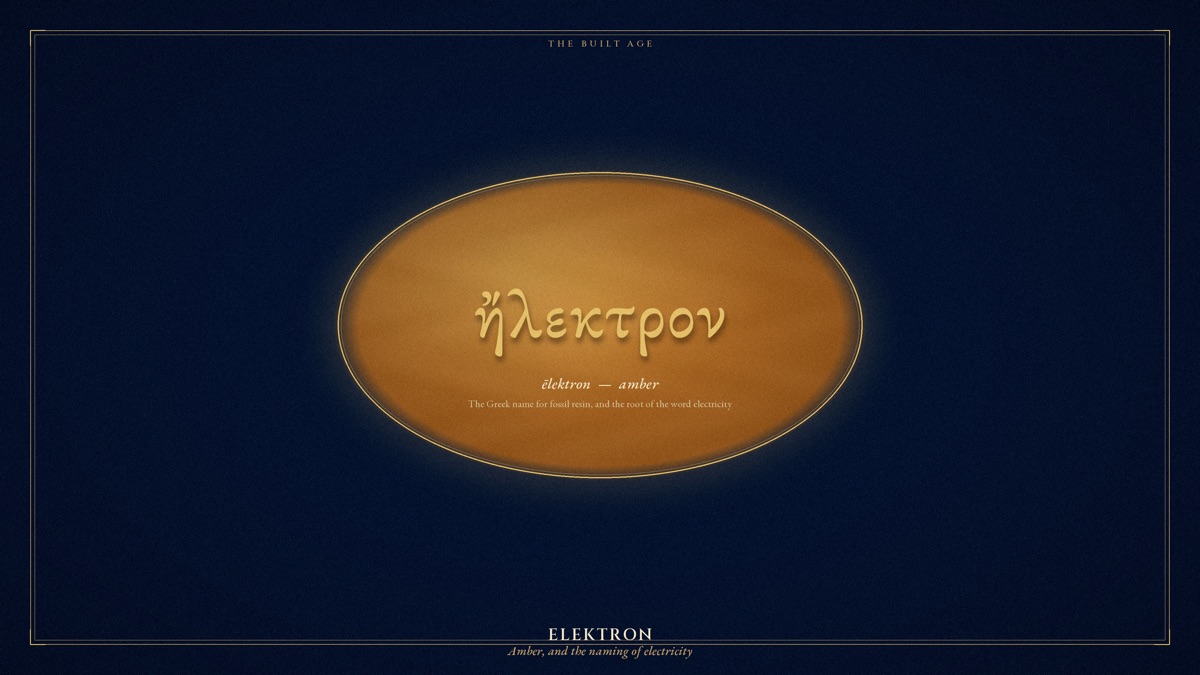
Before we meet him, we need to see what people knew. For most of history, electricity meant two things: lightning, which terrified, and static, which amused. The Greeks noticed that rubbing amber made it attract feathers. The word electricity itself comes from the Greek word for amber, elektron.
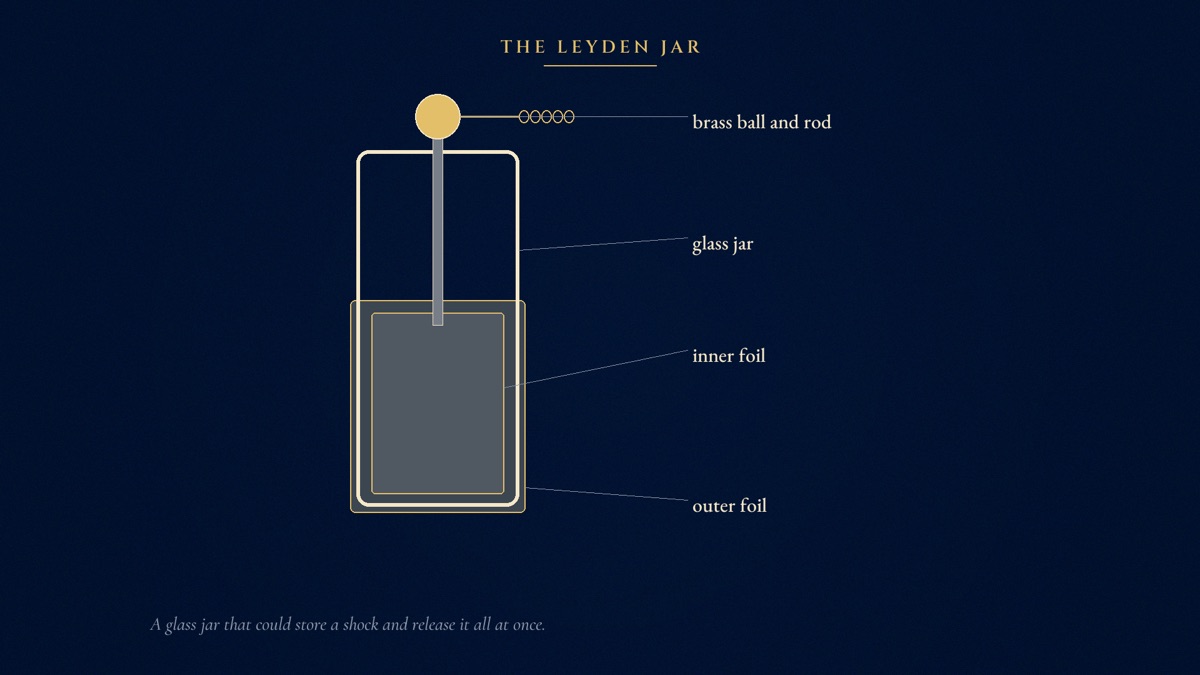
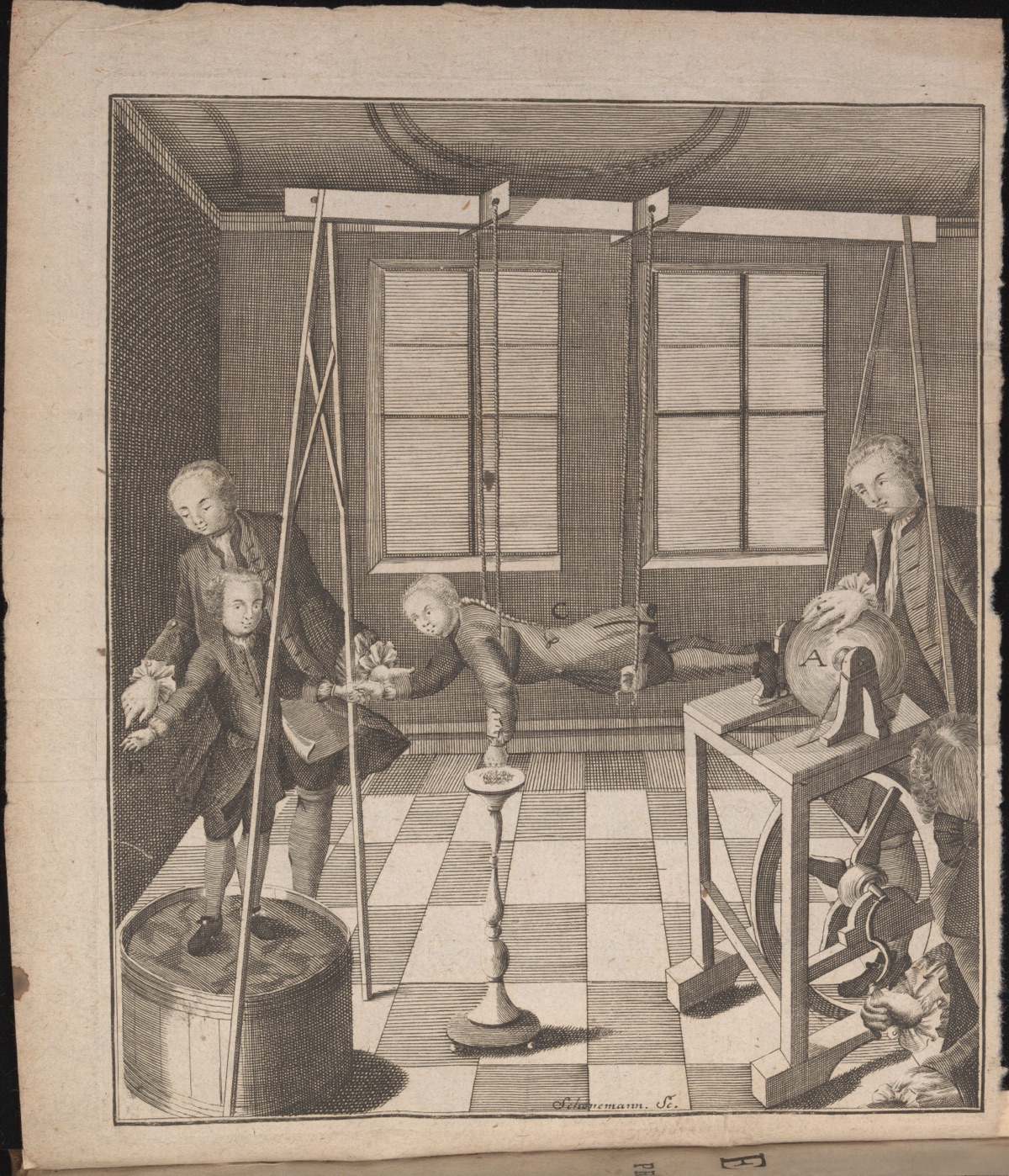
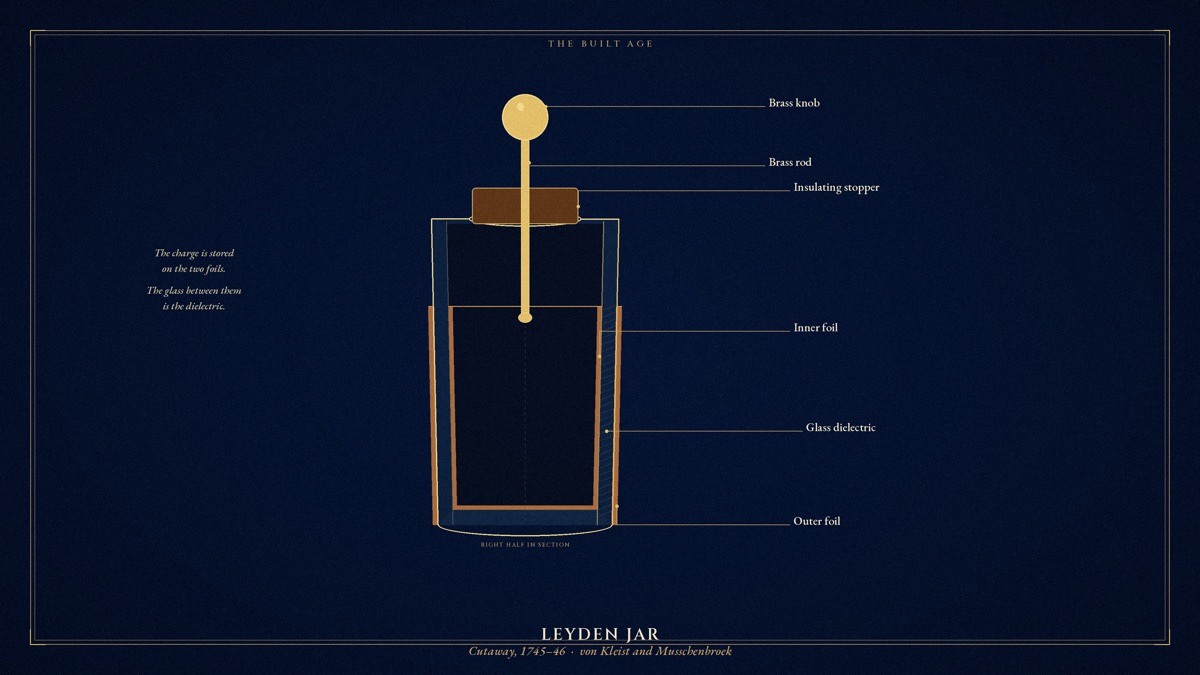
In the eighteenth century, experimenters built machines to make static electricity on demand. They spun glass globes against leather pads and collected the charge in a jar. The Leyden jar, invented in the 1740s, could store a shock and release it all at once. Lines of people held hands while one end touched the jar, and the whole chain jumped together. It was a sensation.
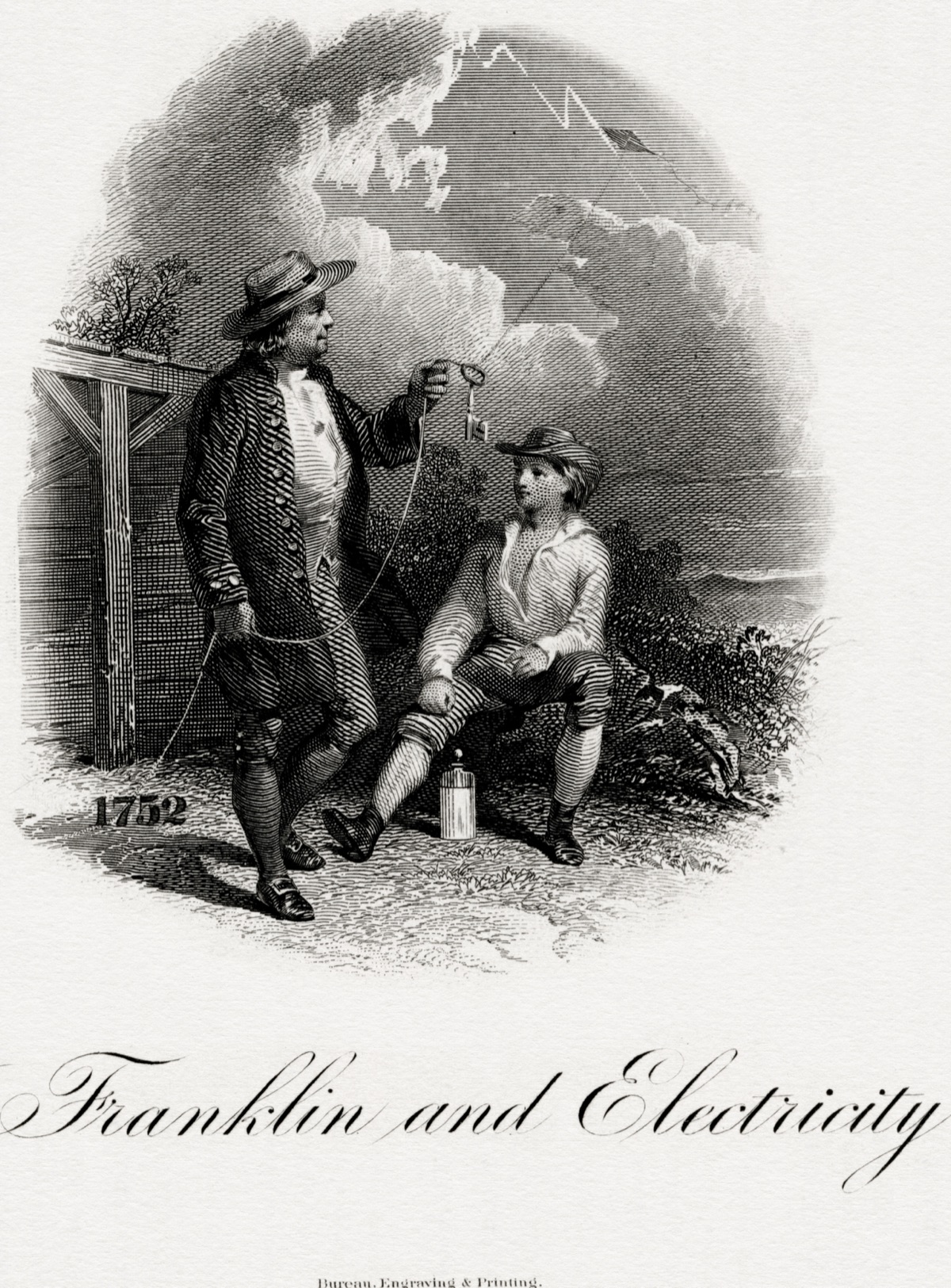
Benjamin Franklin pushed the idea further. He proposed that lightning was electrical, and by the early 1750s, experimenters in France and in America had shown that a storm cloud could indeed fill a jar. Franklin gave us the lightning rod and a lasting vocabulary of positive and negative. But there was a problem. All of this was static. A charge piled up, it discharged in a flash, and it was gone. You could not run anything with it.
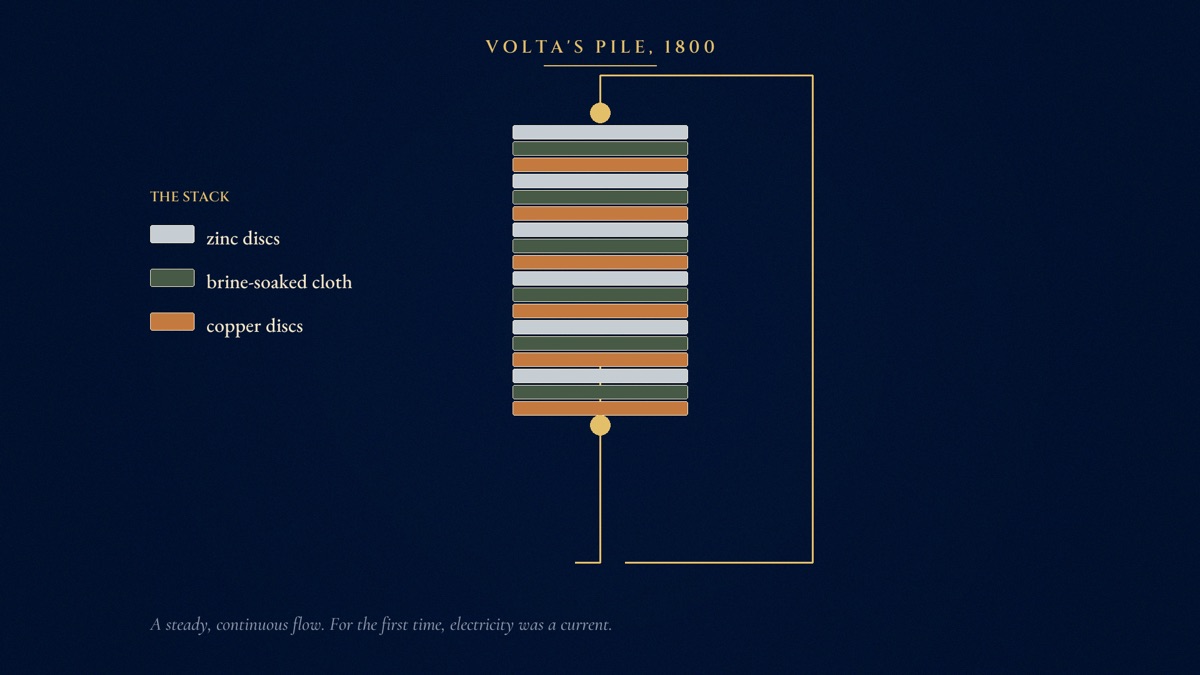
Then, in 1800, an Italian physicist named Alessandro Volta stacked discs of zinc and copper separated by cloth soaked in brine. The pile produced a steady, continuous flow. For the first time, electricity was not a flash; it was a current.
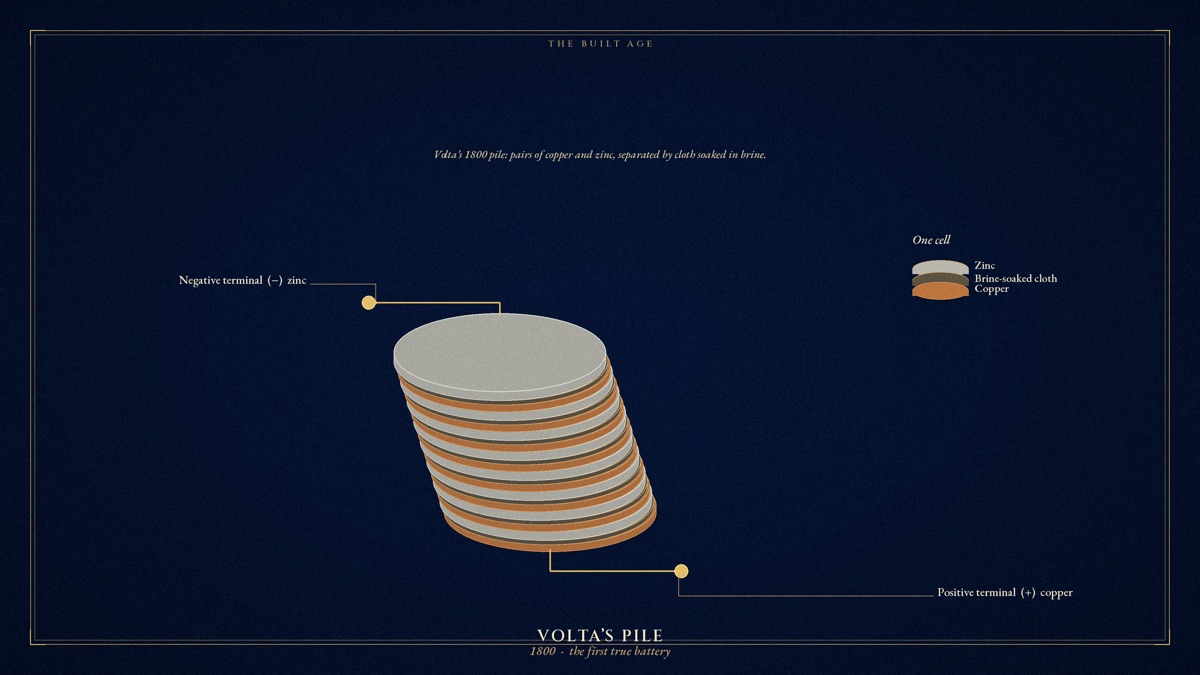
Now there was a source that would keep going. But it was weak, expensive, and consumed metal as it ran. A battery could ring a bell or twitch a frog's leg. It could not light a city. To do that, someone had to discover a completely different way to make electricity. And the clue, as it turned out, was hiding in a magnet.
The apprentice
In 1820, a Danish professor named Hans Christian Ørsted was lecturing when he noticed something odd. When he switched on a current in a wire, a nearby compass needle twitched. An electric current created a magnetic effect. News of the discovery raced across Europe within weeks. Electricity and magnetism, two forces everyone had treated as separate, were somehow connected.
Which brings us to the bookbinder's shop. Michael Faraday was born in 1791 on the edge of London, the son of a blacksmith. His family was poor and his schooling was brief. At fourteen, he was apprenticed to a bookbinder, a trade that involved stitching, gluing, and reading whatever passed across the bench.
And he did read. He read an encyclopedia article on electricity as he bound it. He built small electrical devices from scrap. A customer noticed his curiosity and gave him tickets to a series of lectures at the Royal Institution, given by the celebrated chemist Humphry Davy. Faraday went, took careful notes, then bound them into a handsome volume and sent them to Davy, along with a request for a job.
Davy hired him in 1813 as an assistant. It was not glamorous work. Faraday washed bottles, set up apparatus, and took notes. But he was also surrounded by the finest instruments in England, and he used every spare hour to test his own ideas. Social class still separated them. Faraday was never allowed to forget he had started as a servant. Yet within a few years his experiments would surpass his master's.
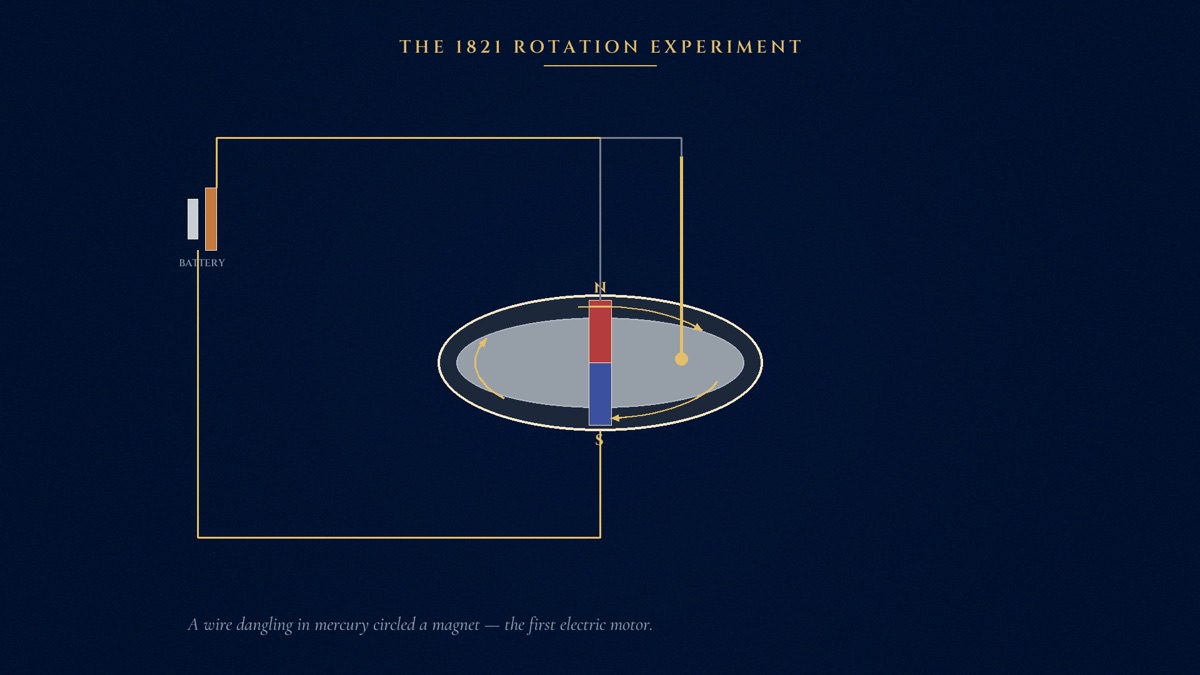
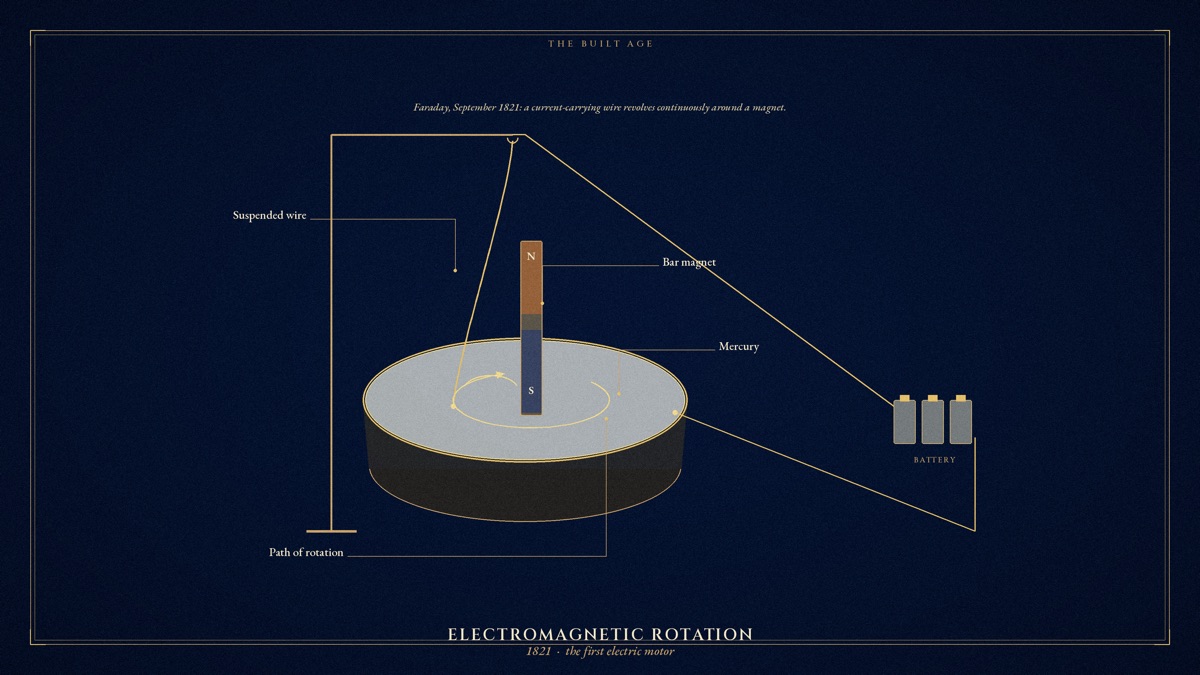
In 1821, inspired by Ørsted, Faraday built a simple device: a wire dangling in a dish of mercury, with a magnet standing in the middle. When current flowed, the wire circled the magnet, round and round. It was the first electric motor, nothing more than a wire turning. But it proved that electricity could produce continuous motion. The reverse question came to him almost at once. If electricity can create magnetism and motion, could magnetism create electricity?
That question would take him ten years.
The ten-year question
The search was harder than it sounds. Faraday tried placing magnets near wires, wrapping coils around magnets, passing currents near other circuits. For most of a decade, he got nothing, or at best, flickers he could not repeat. Other scientists tried too, including the American Joseph Henry, working independently. The answer seemed to be just out of reach.
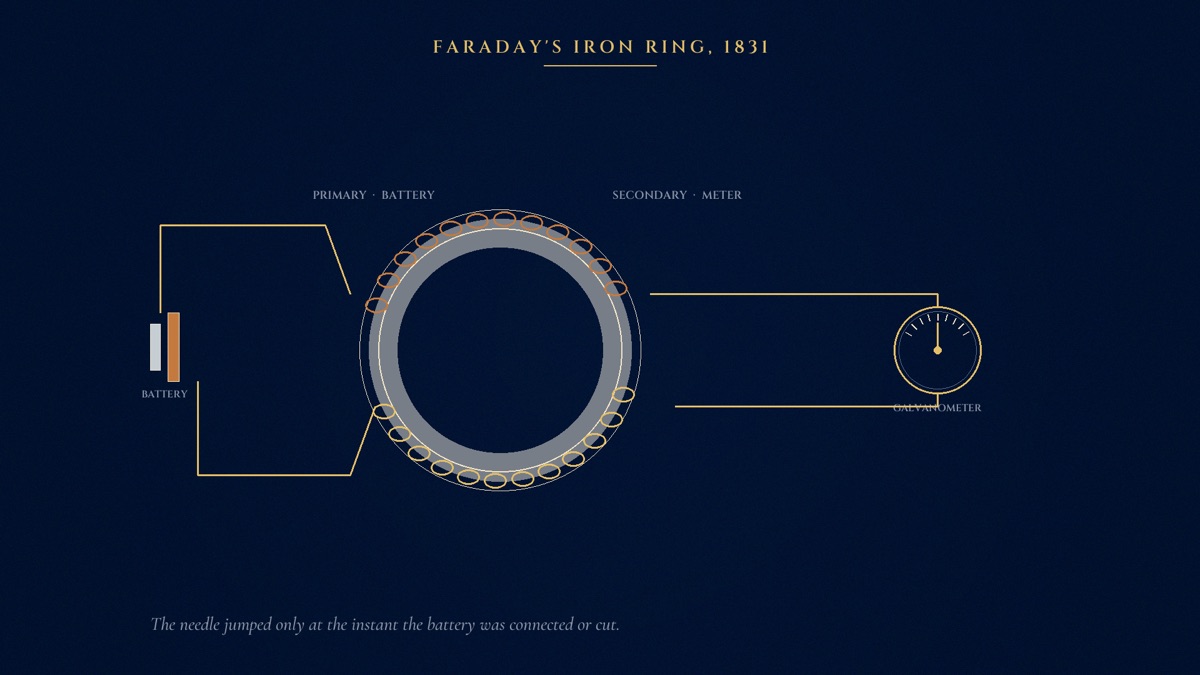
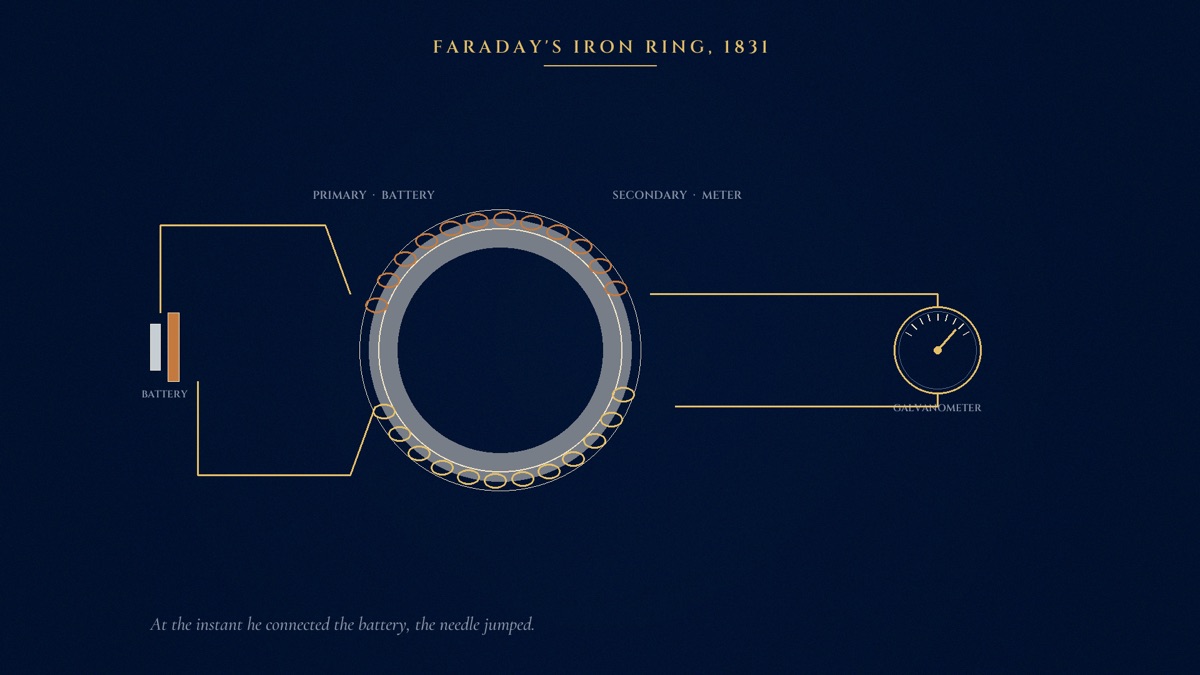
The breakthrough came in the summer of 1831. Faraday wound two separate coils of wire on opposite sides of an iron ring. One coil connected to a battery. The other connected to a galvanometer, an instrument that moves when current flows. He expected the second coil to show a steady current while the first was on. It did not.
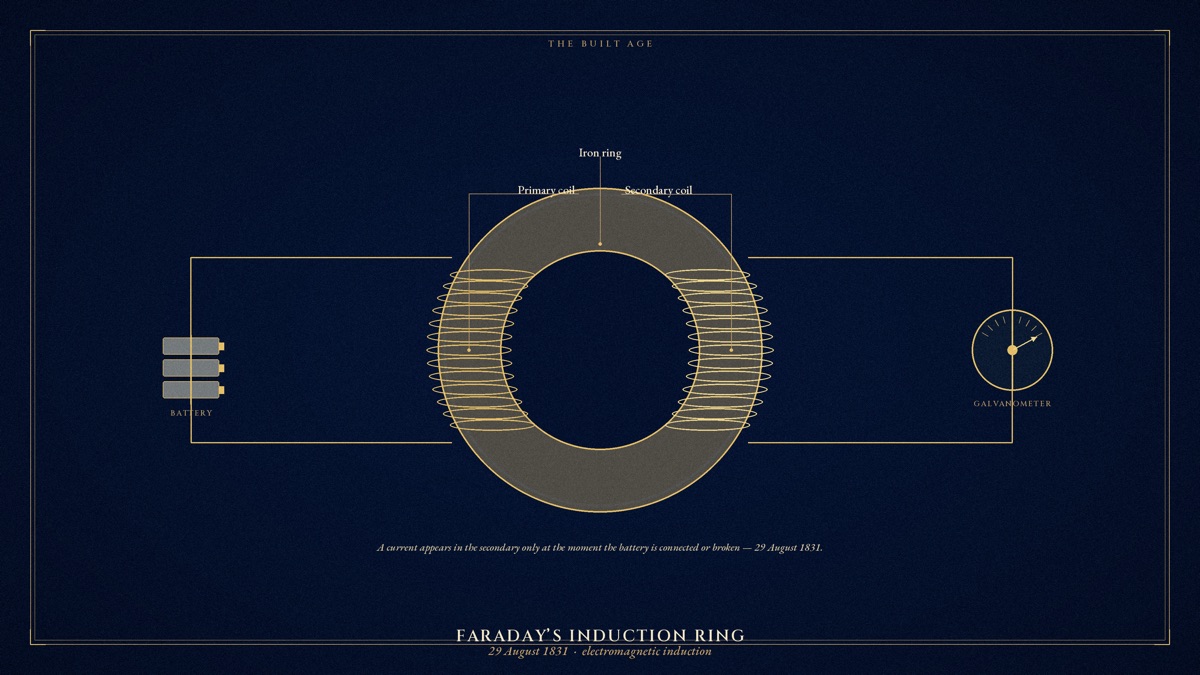
But here is what happened. At the instant he connected the battery, the needle jumped. It settled. Then, when he disconnected the battery, it jumped again, the other way. The effect was not about steady current, but about change. A changing magnetic field, one that grows or collapses, drives a current in a nearby wire.
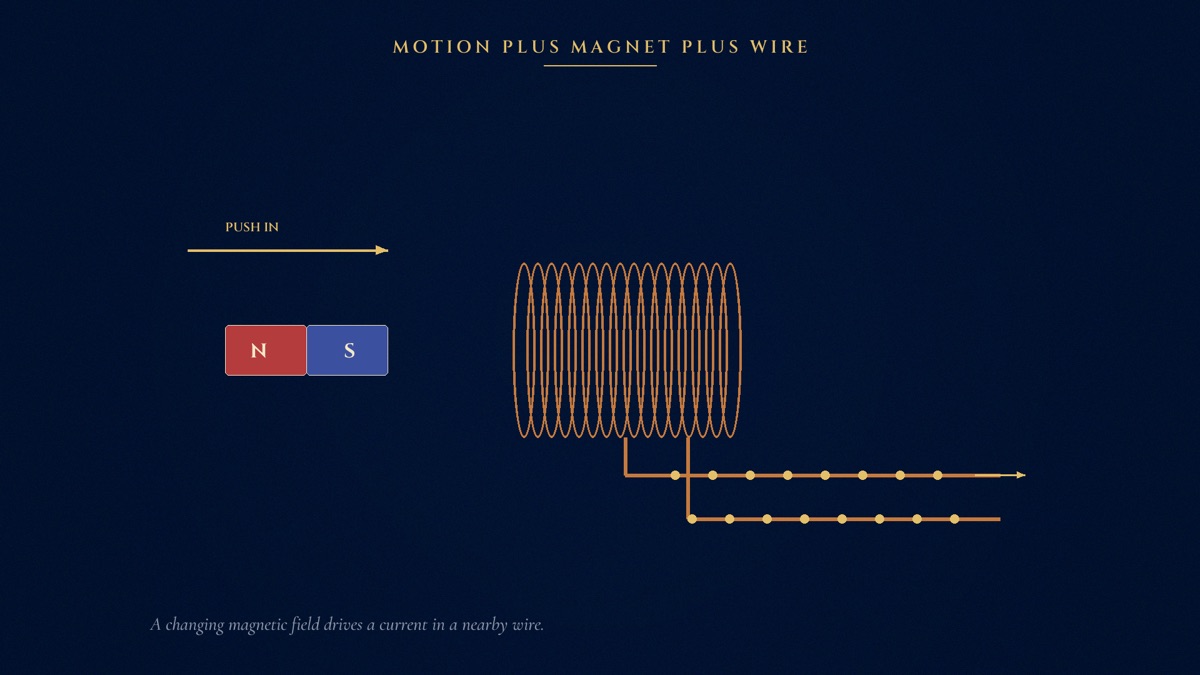
A few weeks later, in October, he proved it with a simpler setup. He pushed a bar magnet into a coil of wire, and the needle moved. He pulled it out, and the needle moved the other way. Motion plus magnet plus wire equals electricity. That is electromagnetic induction.
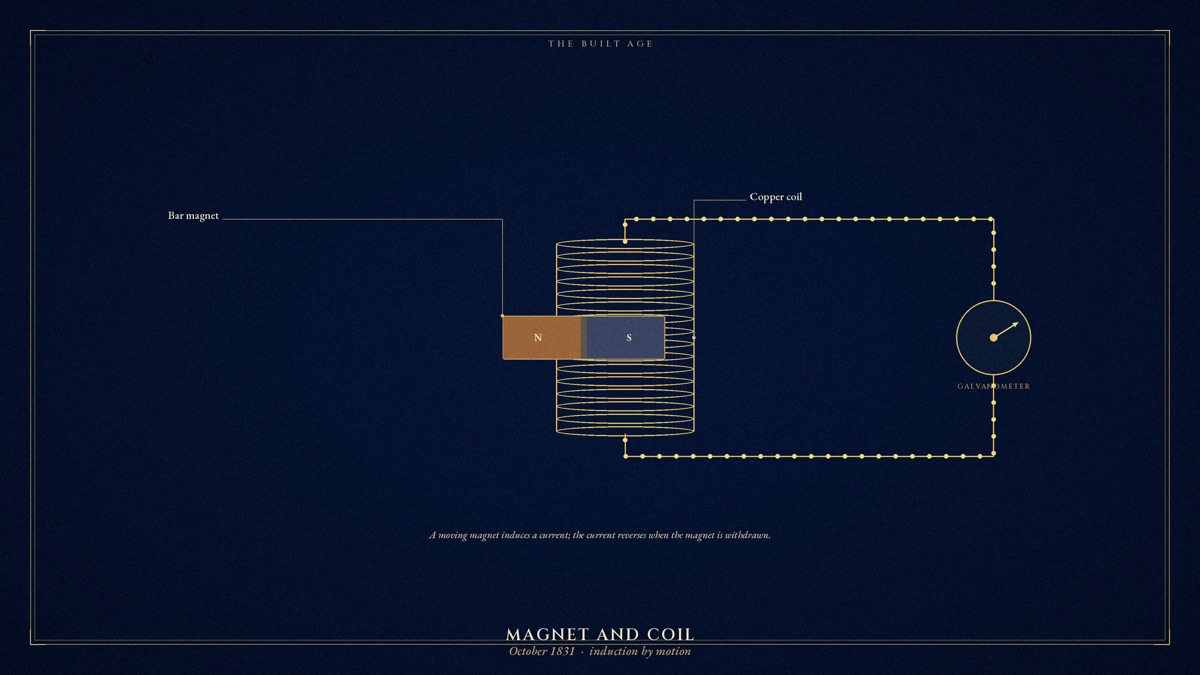
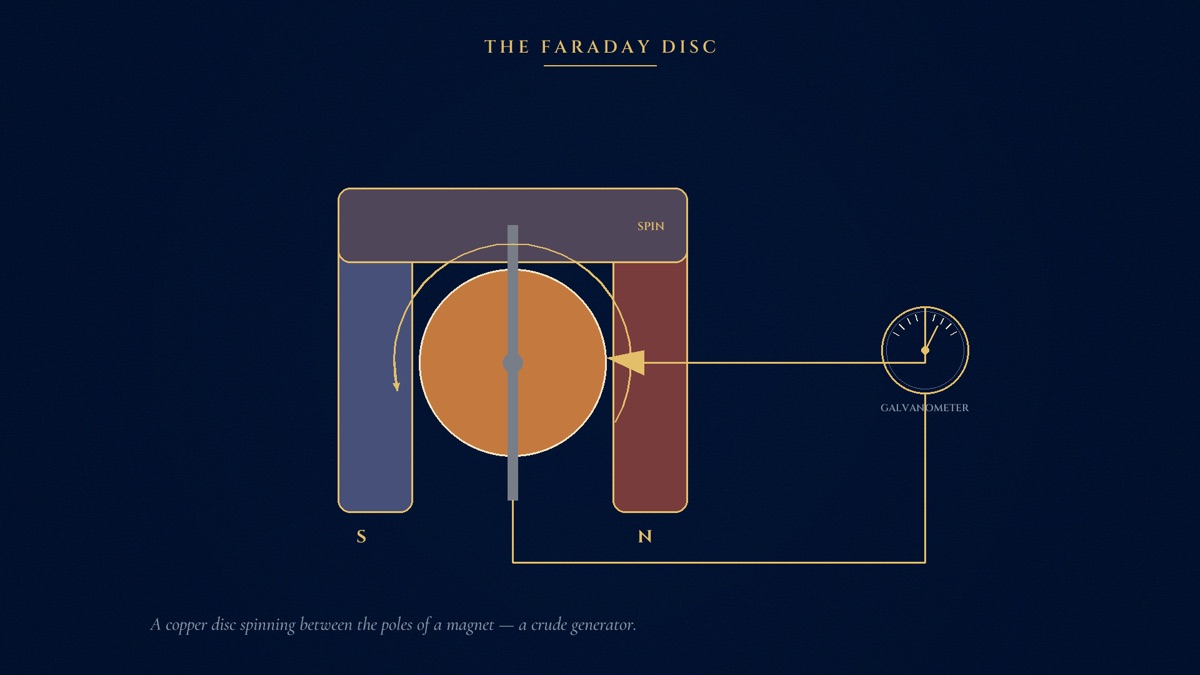
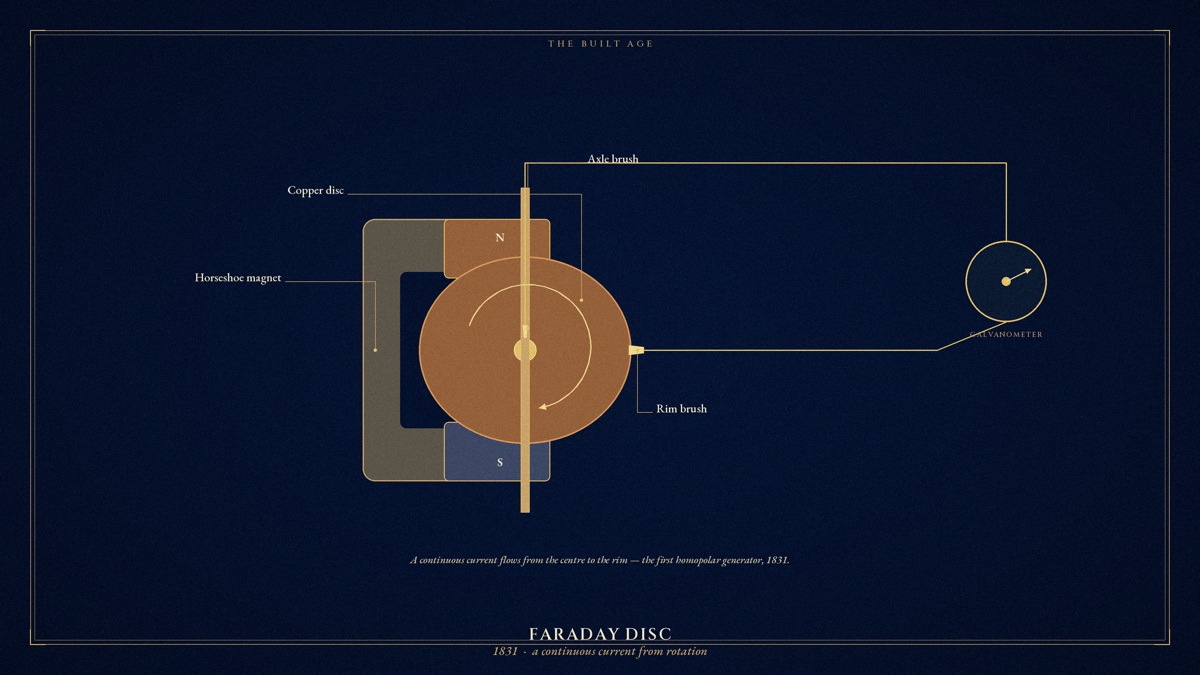
Why does this matter? Because now electricity no longer needed a battery. It could be made by motion. If you could keep a magnet and a coil moving relative to each other, you could make current for as long as you could keep turning. Faraday soon built a copper disc spinning between the poles of a magnet, and it produced a steady current. It was a crude generator, and every power plant on Earth is its descendant.
From coil to dynamo
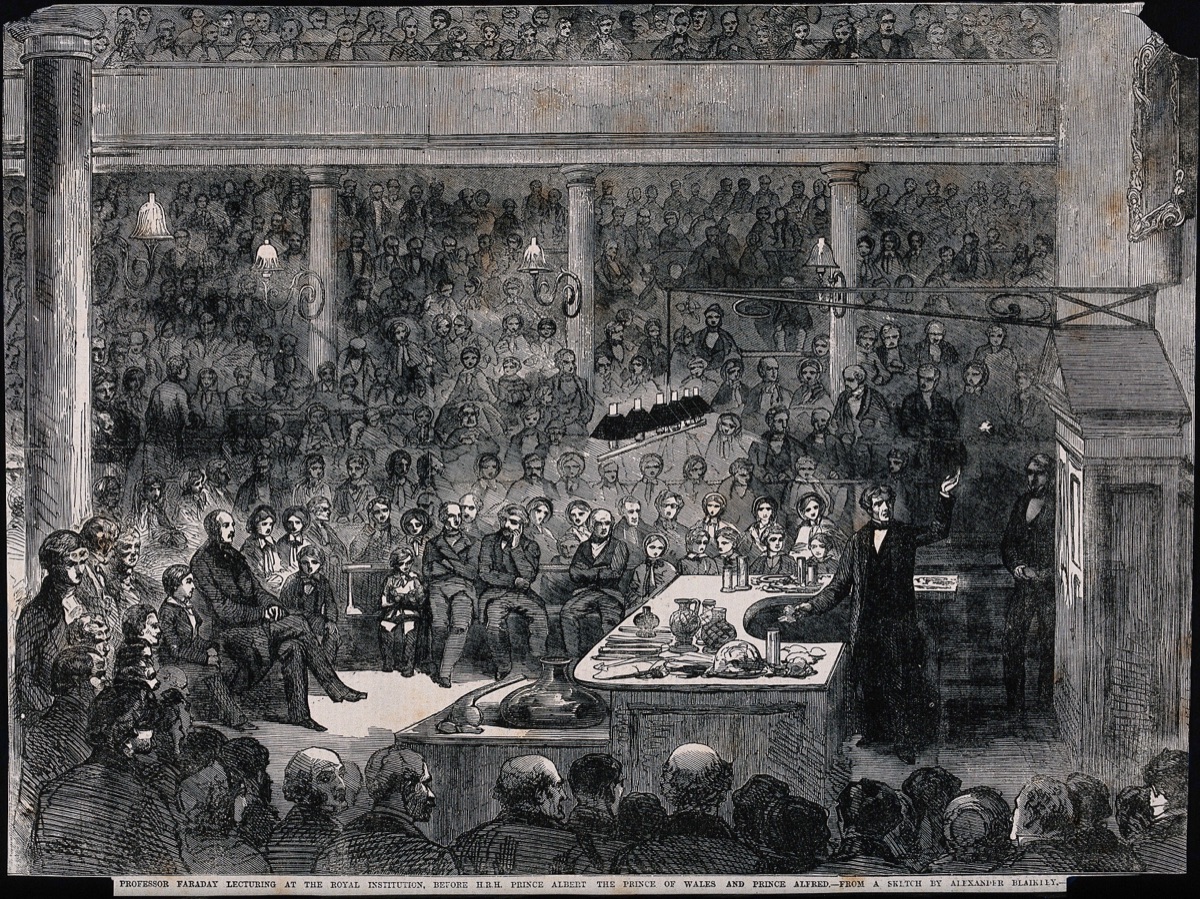
Faraday did not build a power company. He was a scientist more interested in understanding nature than in profit, and he said publicly that he would refuse a knighthood, and he twice declined the presidency of the Royal Society. He kept lecturing instead, including the Royal Institution's famous Christmas Lectures for young people, which continue today.
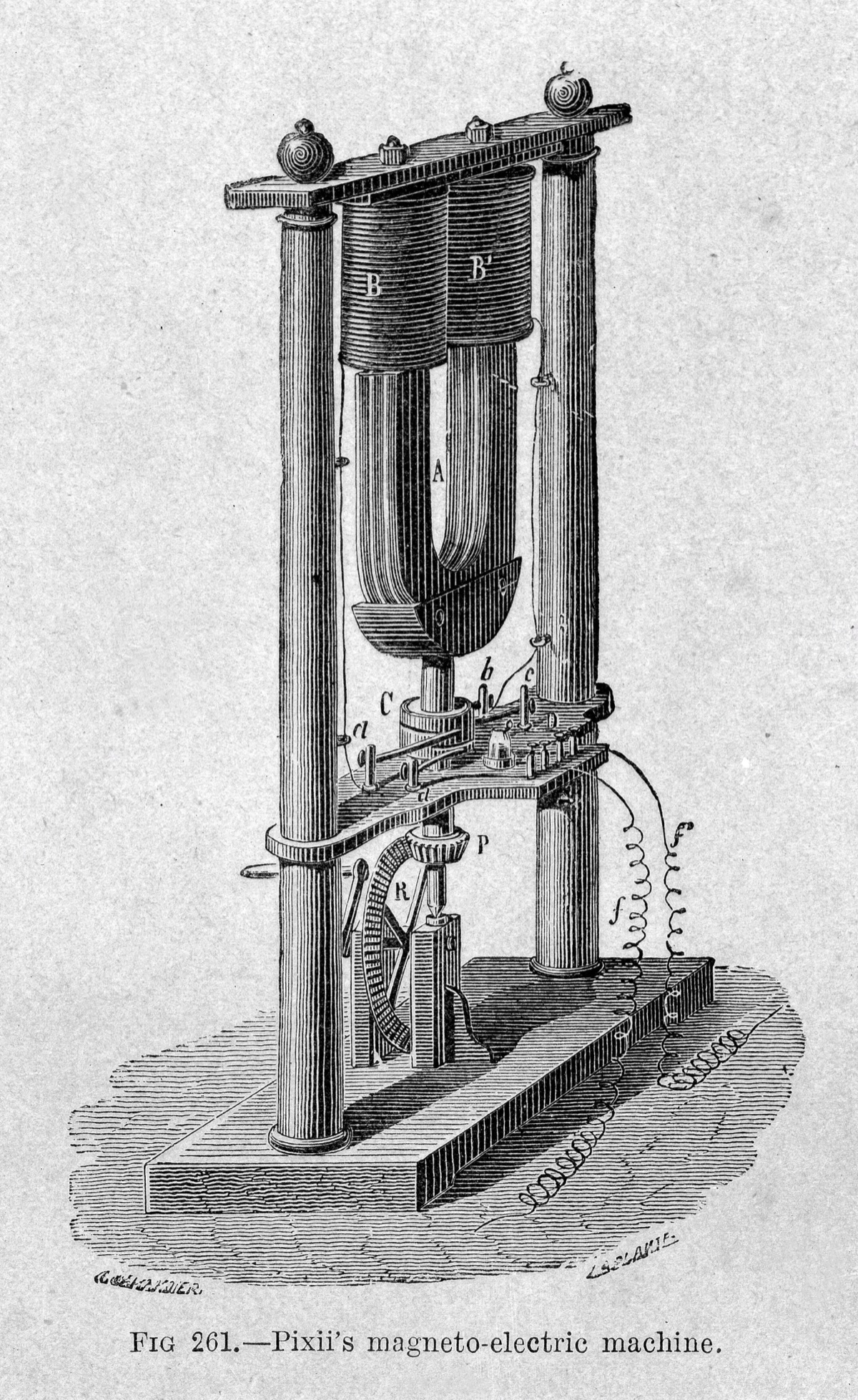
That left the engineering to others. In 1832 a French instrument maker named Hippolyte Pixii built a hand-cranked machine that spun a magnet near coils and produced alternating current. Over the following decades, inventors improved the design. They replaced permanent magnets with electromagnets and found a crucial trick: a generator could use some of its own output to strengthen its magnets. In the 1860s, several inventors, including Werner Siemens in Germany, demonstrated these self-exciting dynamos.
Output rose. Machines that once produced a small spark could now drive an arc lamp, and soon they could power a street. In the 1870s the Belgian engineer Zénobe Gramme built practical dynamos that factories began to buy. Arc lamps flared in lighthouses, theaters, and the new department stores. But arc light was blinding and harsh. Cities needed something gentler for indoors.
That is where the better-known names appear. In the late 1870s and early 1880s, Joseph Swan in England and Thomas Edison in the United States both developed practical incandescent lamps. Edison's team tested thousands of materials for the filament, and the result, a carbonized thread inside a glass bulb with almost no air, first glowed for about fourteen hours in October 1879. Within a year, a filament of carbonized bamboo lasted more than a thousand hours.
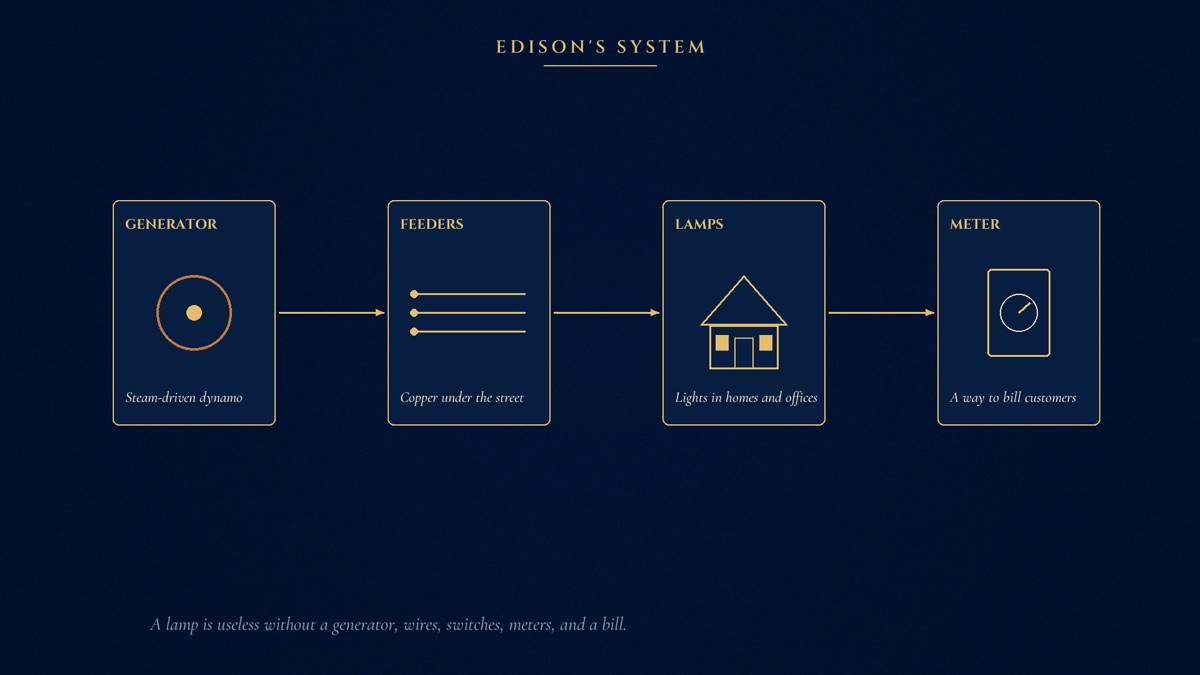
But Edison's real insight was not the bulb. It was the system. A lamp is useless without a generator, wires, switches, meters, and a way to bill customers. He set out to build all of it as one commercial product.
Pearl Street and the first grid
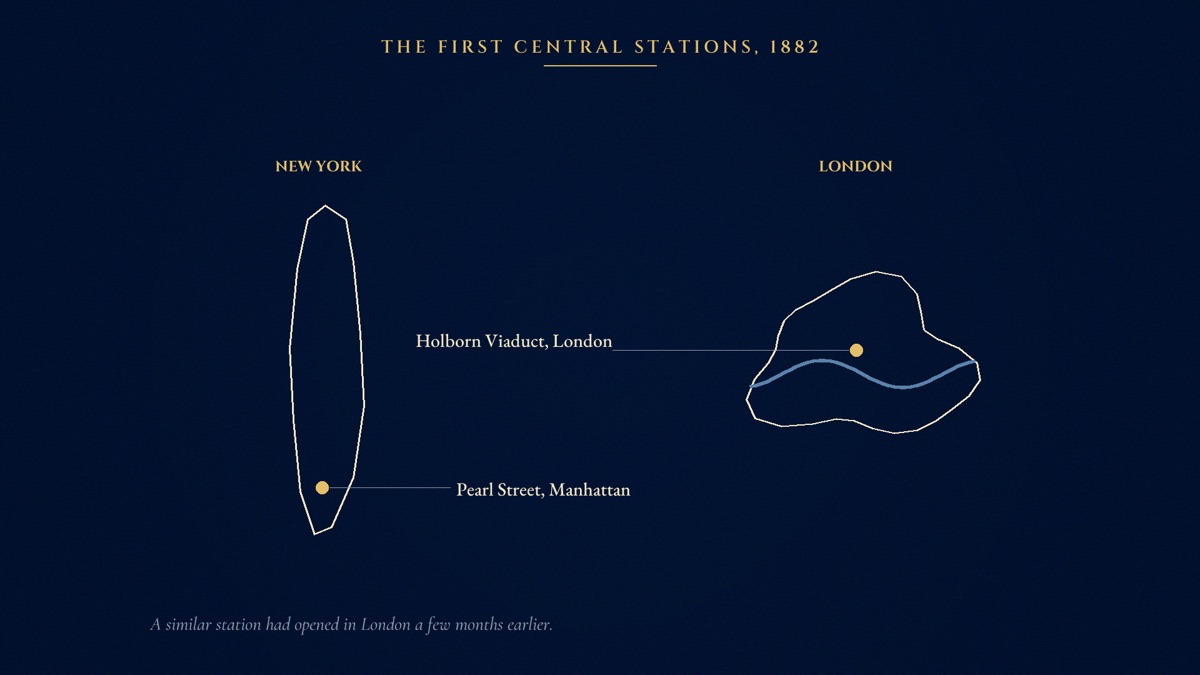
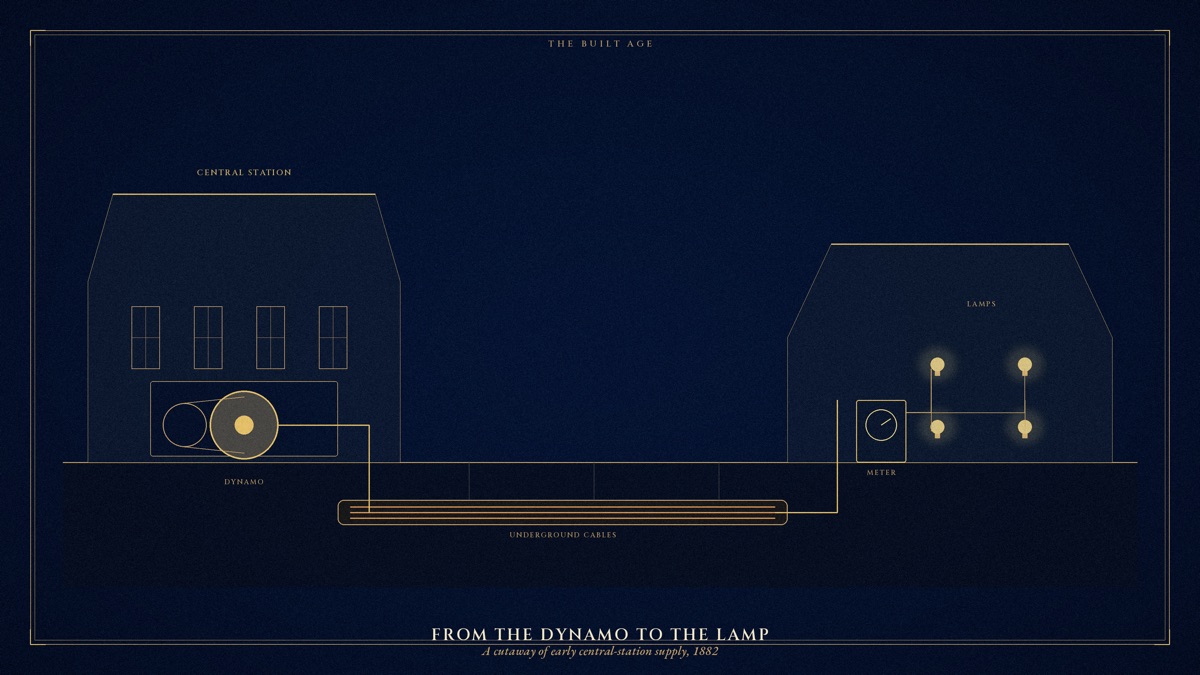
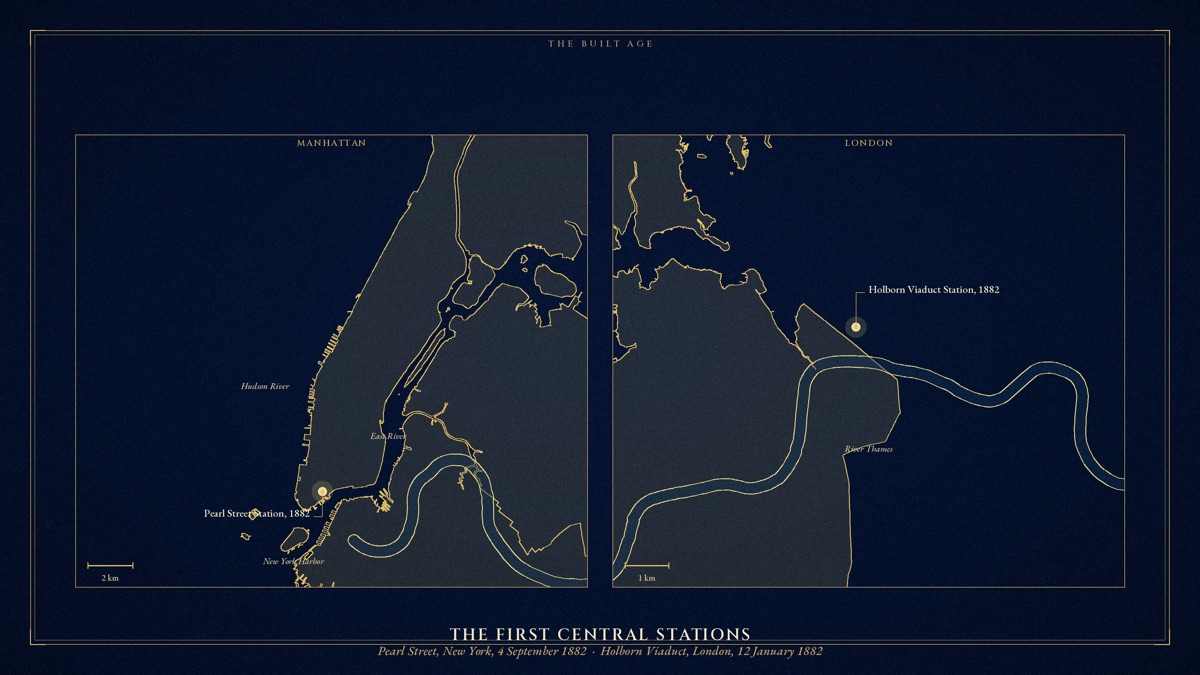
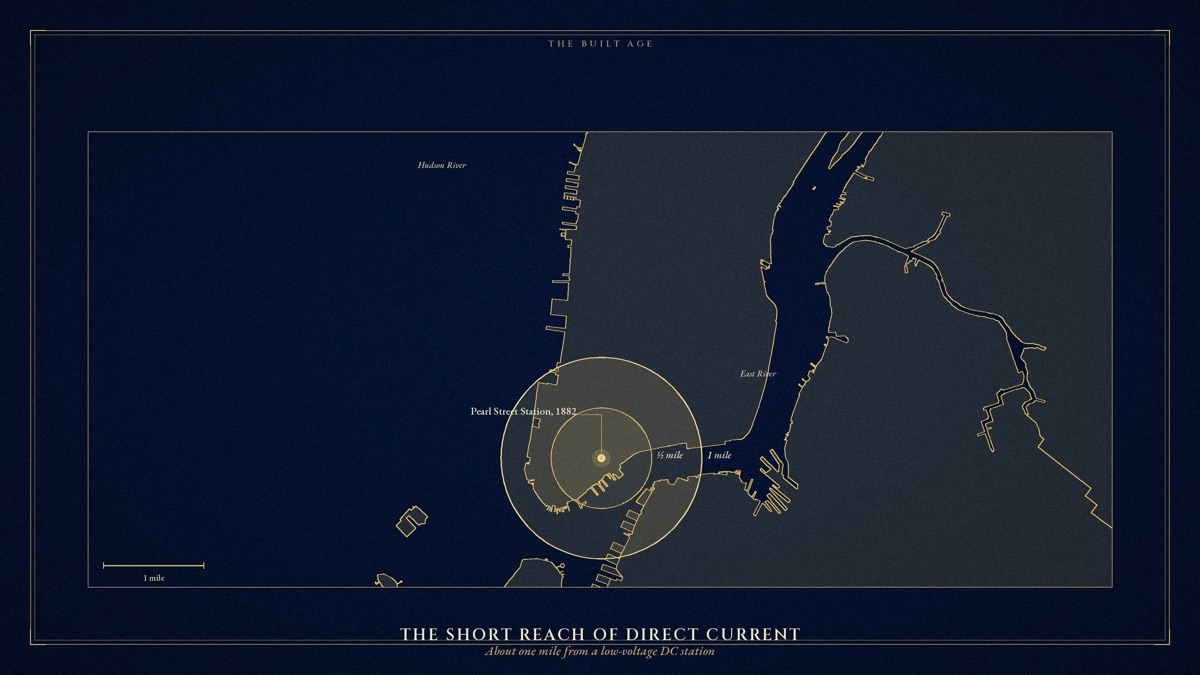
On September 4, 1882, Edison's company switched on the Pearl Street Station in lower Manhattan. Steam engines turned dynamos, and the power ran through underground copper wires to customers nearby, including offices and newspaper buildings. On opening day there were only about 85 customers and roughly 400 lamps, though the six dynamos could have fed thousands more. It was small, it lost money for its first two years, and it served only about a square mile. But it worked.
A similar station had opened in London a few months earlier, at Holborn Viaduct. Across the Atlantic and the Channel, the same pattern repeated: a central station, a local network, a growing waiting list. Electricity was becoming a utility, like gas, but cleaner and more flexible.
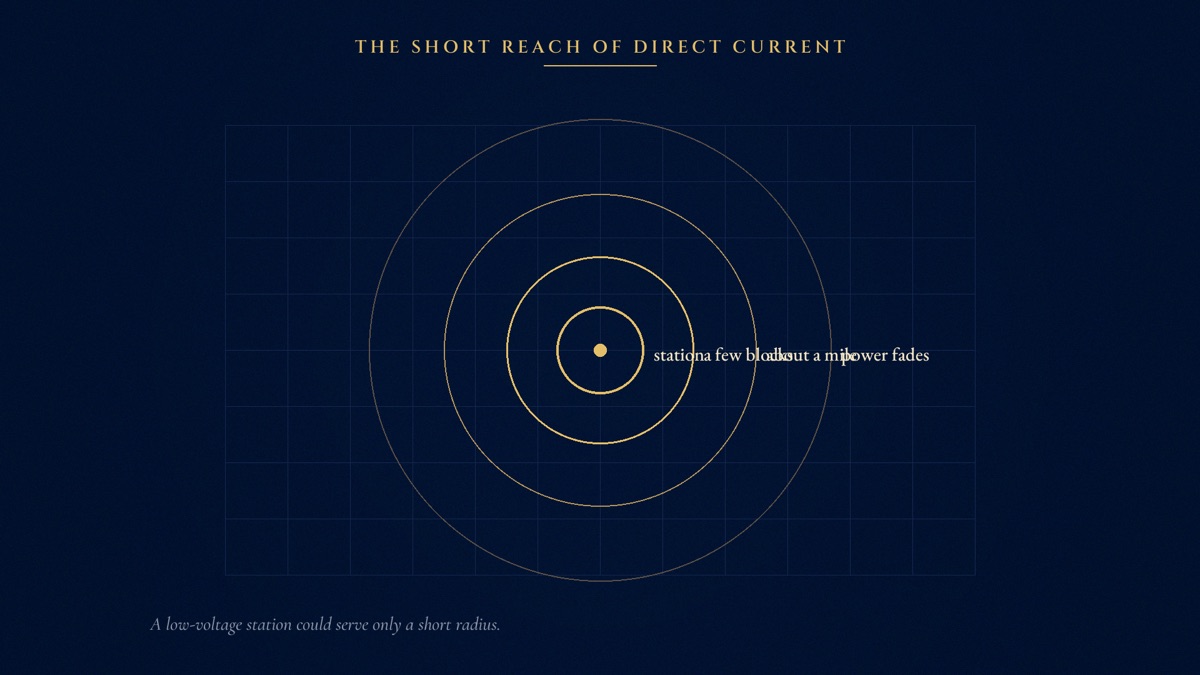
The limits showed up quickly, though. Edison's system used direct current at low voltage, which lost power quickly over distance. A station could serve only a short radius, so cities would have needed a power plant every mile. Customers in the countryside were out of luck.
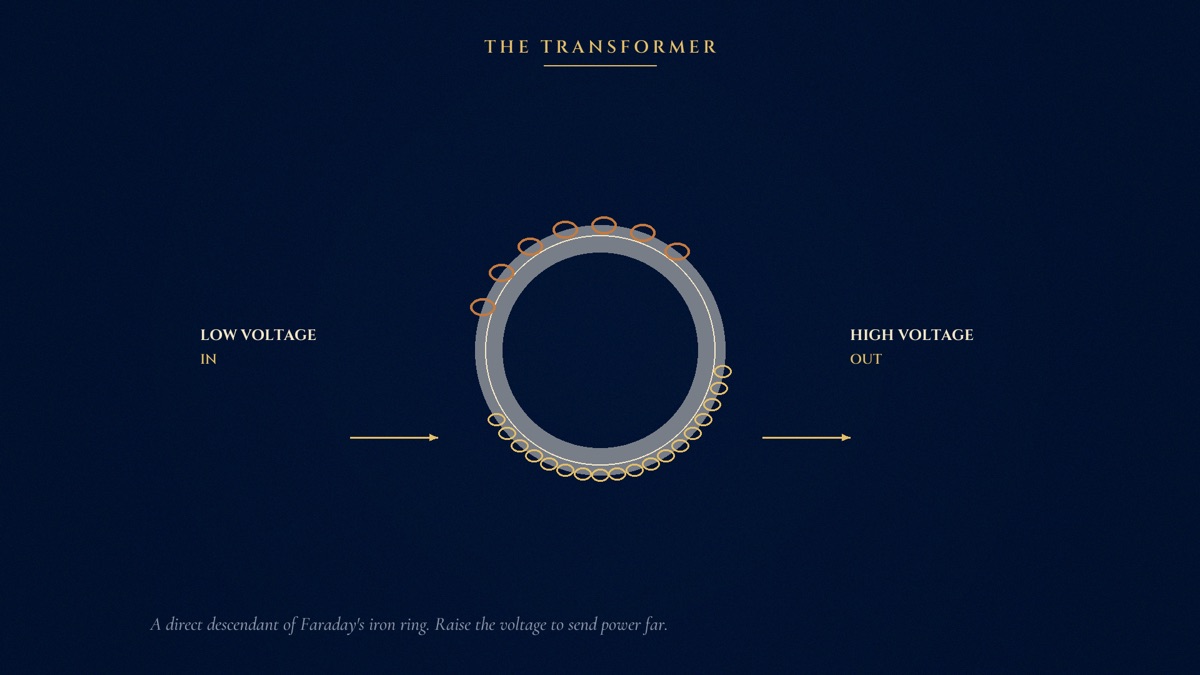
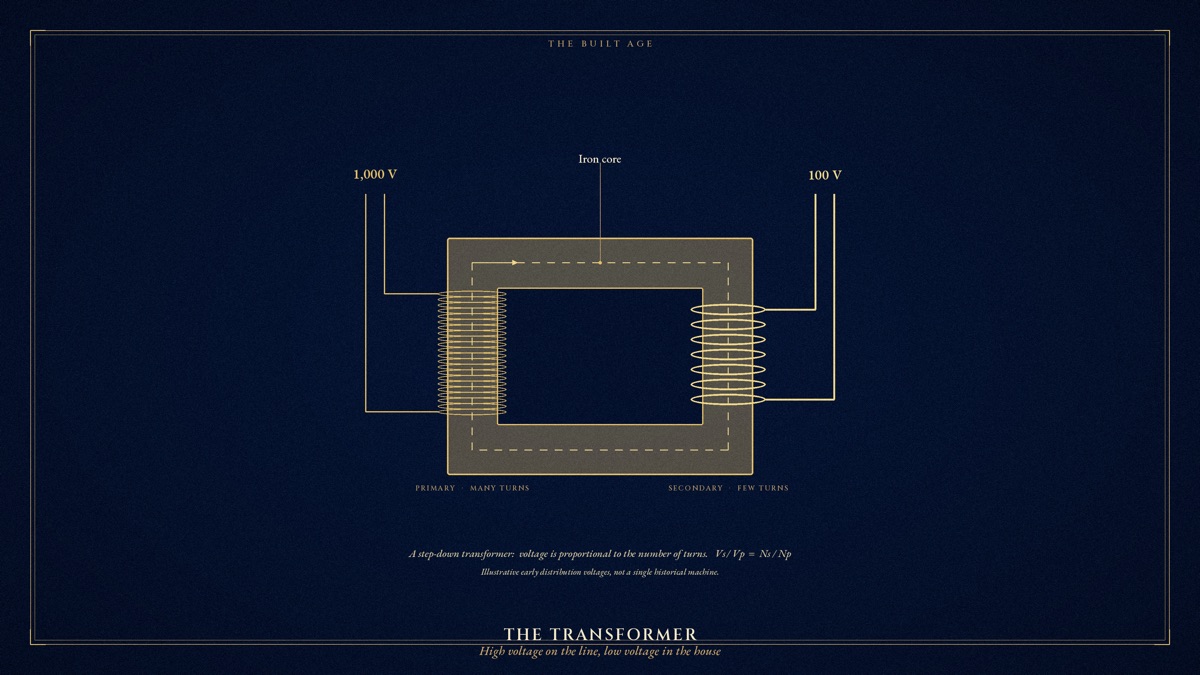
The fix came from a different way to generate electricity, alternating current, and the ability to raise its voltage with a transformer, which is itself a direct descendant of Faraday's iron ring. High voltage can carry power over long distances with far less loss, then be stepped down to a safe level at the end. That led to one of the most famous rivalries in engineering, which we cover in its own film. For now, what matters is the result. By the 1890s, alternating current won the long-distance contest, and with it came the idea of a regional grid.
The world rewired
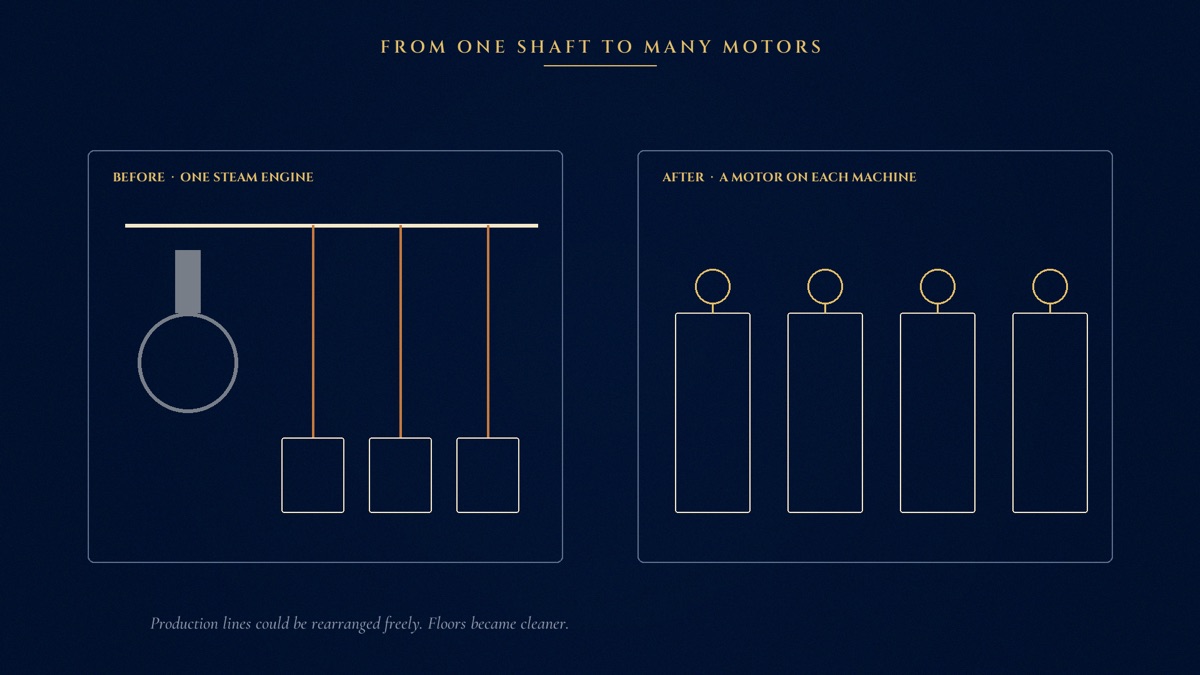
Once power could travel, everything changed. Factories threw out their giant overhead belts and shafts, driven by a single steam engine, and put small electric motors on each machine. Production lines could be rearranged freely. Floors became cleaner, and workers no longer stood under whirling leather belts.
Cities changed shape. Electric streetcars let neighborhoods spread outward. Electric elevators, which we will meet in a later film, let buildings rise. Offices stayed lit long after sundown. Night, for the first time, belonged to people as much as to darkness.
Homes were slower to follow. Wires reached the wealthy first, then the middle classes. In the United States, most farms were still without power in the early 1930s, because private companies did not think rural customers were worth the cost. Only about one farm in ten had electric service as late as 1935. The government created a Rural Electrification Administration in 1935 to help cooperatives build lines, and over the following years, the dark countryside filled in. The same story repeated across the world. It is still being written today in places where millions of people live without reliable electricity.
Along with light came a flood of devices: refrigerators, washing machines, radios, then televisions, and eventually computers. Each one depended on the same hidden fact. A steady supply, delivered on demand, at the flick of a switch.
The balancing act
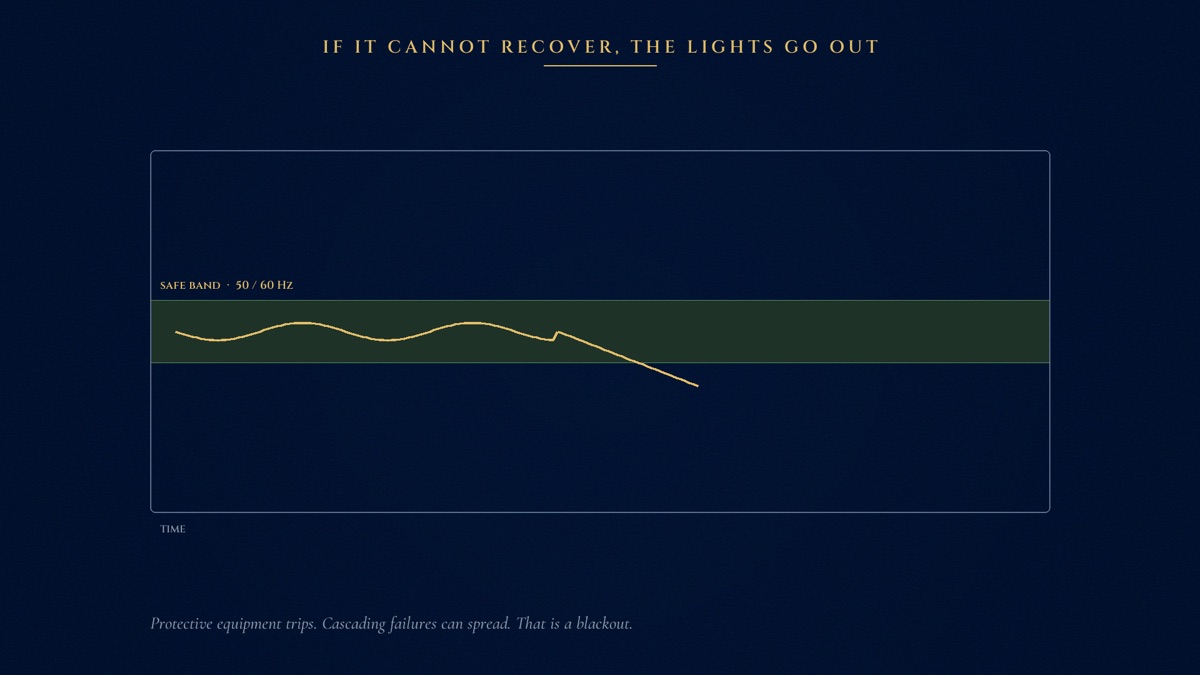
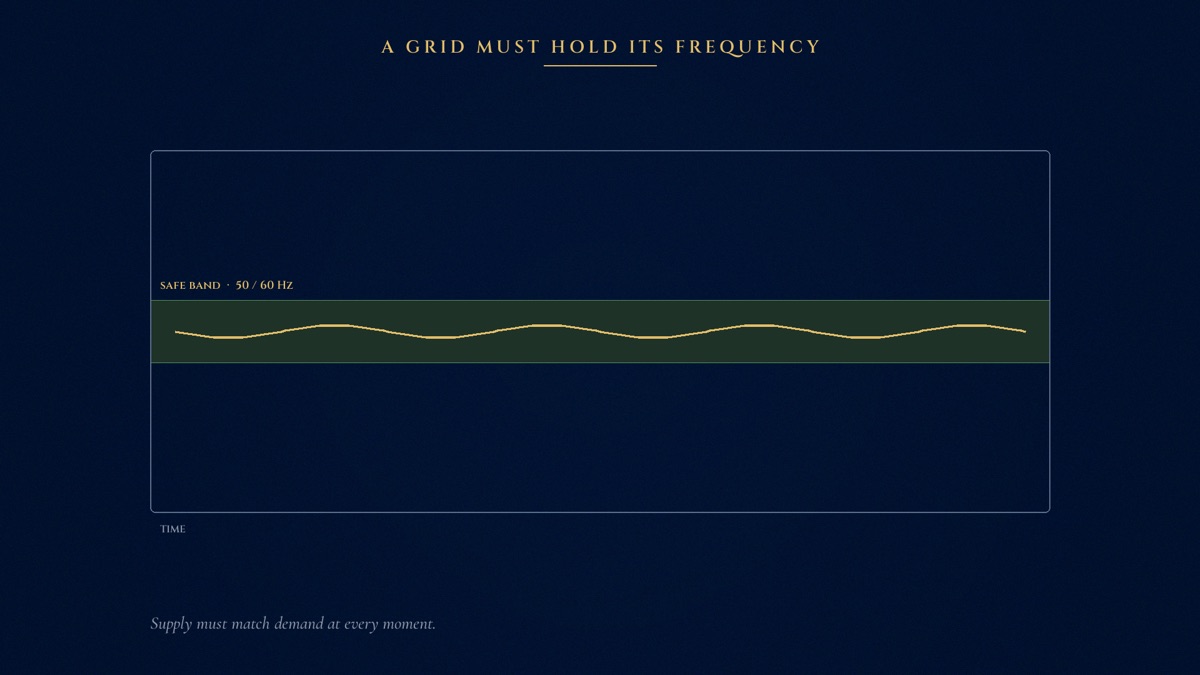
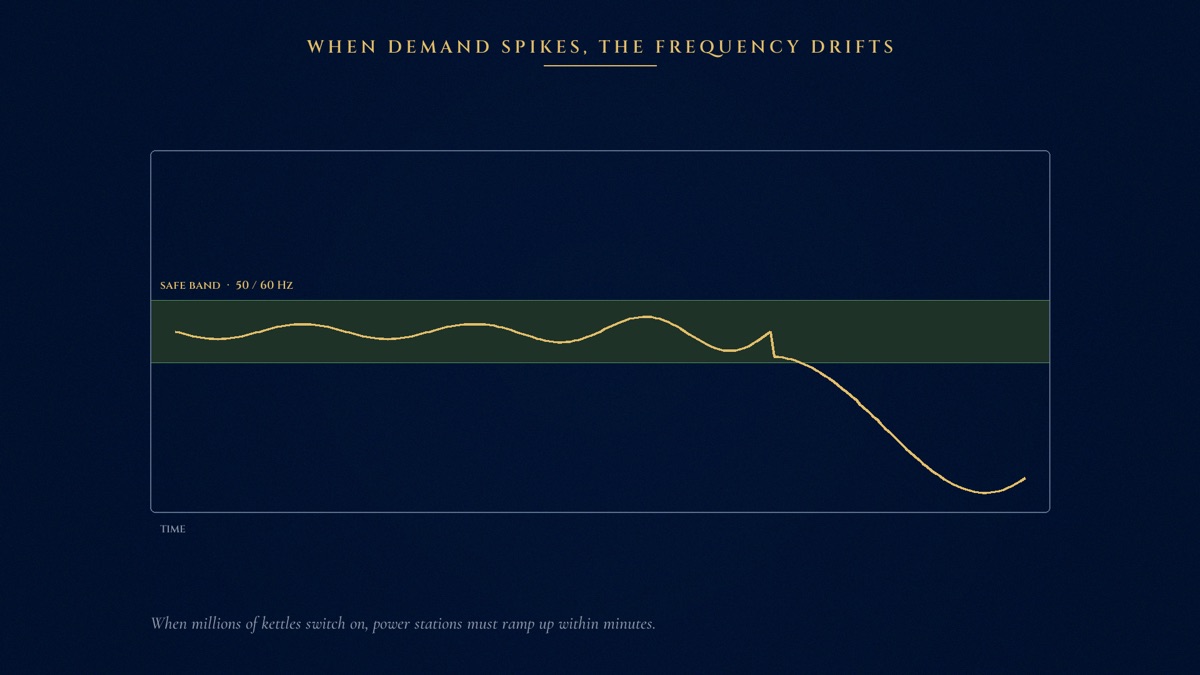
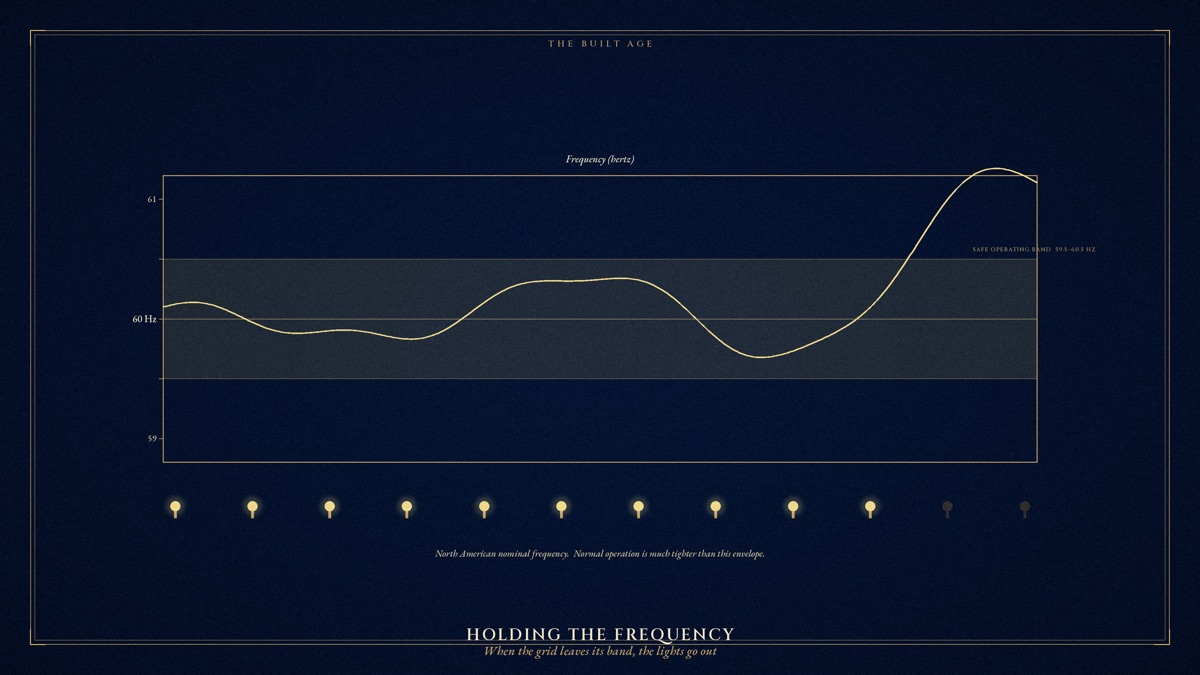
Modern grids are among the largest machines ever built. And they have an odd property: electricity cannot be stored cheaply in bulk, so supply must match demand at every moment. When millions of people turn on kettles at half time during a big match, power stations must ramp up within minutes. If they cannot, the frequency drifts, and protective equipment trips to prevent damage. Cascading failures can spread. That is a blackout.
That is why the next chapter of this story is about storage and flexibility, which we will return to in our film on the battery. It also explains why Faraday's century-old discovery still shapes the news. Wind turbines, solar farms, nuclear reactors, and gas plants all feed the same grid. Most of them still end in a spinning magnet near a coil. Solar panels are the great exception, producing power without moving parts.
And here is the thread worth holding on to. Faraday began as a boy with almost nothing. He had no formal training and no fortune. What he had was a question, and the habit of testing it patiently, again and again, until the world answered. The modern grid is the long echo of that answer.
Next time you flip a switch, remember the needle that twitched on a bench in 1831, and the apprentice who watched it.
Next Monday, we turn to the metal that let cities climb: steel. And later in this series, the rivalry that decided which kind of current would reach your home gets a film of its own. If you want to follow the whole story, subscribing to The Built Age is the simplest way.
Watch the full Electricity documentary with all 27 diagrams, 5 archival images, and narration.
Watch on YouTubeSources & Further Reading
- Royal Institution, Michael Faraday (1791-1867) — https://www.rigb.org/node/2696
- Encyclopaedia Britannica, "Michael Faraday" — https://www.britannica.com/biography/Michael-Faraday
- Thomas, J. M., *Michael Faraday and the Royal Institution: The Genius of Man and Place* (Adam Hilger, 1991)
- James, F. A. J. L. (ed.), *The Correspondence of Michael Faraday* (IET)
- Faraday, M., *Experimental Researches in Electricity* (1839–55) — public domain
- Jonnes, J., *Empires of Light* (Random House, 2003)
- IEEE Milestone, Pearl Street Station, 1882 — https://ethw.org/Milestones:Pearl_Street_Station,_1882 ; ETHW Pearl Street Station — https://ethw.org/Pearl_Street_Station
- ETHW, Edison's Incandescent Lamp — https://ethw.org/Edison%27s_Incandescent_Lamp
- History.com, rural electrification — https://www.history.com/articles/new-deal-great-depression-rural-electrification
- Museo Galileo, Pixii machine c.1832 — https://catalogue.museogalileo.it/object/MagnetoelectricMachineByPixii.html
- ETHW, Dynamo — https://www.ethw.org/Dynamo
- Holborn Viaduct power station — https://en.wikipedia.org/wiki/Holborn_Viaduct_power_station